Ice-Breakers

Fun icebreaker games & activities that invite people to interact, share & laugh together

How often have you walked into a room full of strangers and been met with silence? Arms folded, eyes on phones, everyone waiting for someone else to make the first move. That’s the ‘ice’. And until it melts, your group is unlikely to get much done.

Icebreaker games help people get to know one another, strengthen relationships and have fun. When designed and facilitated appropriately, they are always conducted in a non-threatening manner, are success-oriented and require minimal verbal and decision-making skills.

If your group doesn’t know each other, a good icebreaker gives everyone a comfortable way to start. Even if your group knows one another quite well, these simple, fun and highly interactive games and activities will always start your program with a few laughs.


What Is An Icebreaker?

In short, an icebreaker is any experience that breaks the ‘ice’ that typically limits or inhibits the interactions of a group of people who may or may not know each other very well. Common occurrences of ‘ice’ include little or no talking, poor eye contact, reluctance to make physical contact, lots of standing around, lack of initiative, absence of trust, arriving late or leaving early.

A good icebreaker acknowledges these facts, and intervenes. When presented appropriately, with full regard to the needs of the group, an icebreaker will reduce, minimise (and hopefully eliminate) the impact of the ‘ice’ and invite the group to create a more productive atmosphere, one that is conducive to working together or achieving whatever the purpose of the group is.

In essence, an icebreaker prepares your group for its purpose. Without this necessary preparation, your group is less likely to be as successful as it could be.

It’s just as useful to be clear about what an icebreaker is NOT:

  • It’s not simply the first activity of the day. Adding a game to the start of your program does not make it an icebreaker. It has to actually break the ice.
  • It’s not the dreaded go-around, where everyone stands up in turn to introduce themselves. Most people are busy rehearsing what they will say rather than listening, and for many it is the most threatening part of the day.
  • It’s not a test of how much people are willing to reveal. Asking strangers to share their most embarrassing moment is more likely to freeze a group than warm it up.
  • It doesn’t have to be a game. A warm smile and a handshake at the door, or an interesting puzzle waiting on the tables, can break the ice just as well.

That said, I happen to believe that icebreakers which come in the form of games and activities are particularly useful, because they are engaging, fun and very transferable.

Five Essential Ingredients of a Great Icebreaker

As I describe in Serious Fun and, more recently, in my latest book No Props No Problem, all successful icebreakers reflect most, but hopefully ALL, of the following five characteristics:

  1. Fun and laughter as a major component
  2. Non-threatening invitations to play
  3. Highly interactive experiences
  4. Simple and easy-to-understand instructions
  5. A success-oriented design

So, if an activity or experience you are considering does not tick off 3, 4 or (hopefully) all 5 of these attributes and you’re still calling it an icebreaker, don’t do it. It is highly unlikely to prepare your group for whatever you have in store for them.

Playing icebreaker for groups who know each other laughing in circle

Icebreakers vs Energisers vs Get-To-Know-You Games

These terms are often used as if they mean the same thing, and there is plenty of overlap. Generally speaking:

  • Icebreakers melt the barriers that stop people interacting. They are most useful at the start of a program, or whenever new people join.
  • Energisers lift the energy of a group that has gone flat, eg after lunch or a long presentation. Your group may already know each other well.
  • Get-to-know-you games help people learn about one another – names, interests, stories. Many make terrific icebreakers, but the focus is on what is shared.

In practice, many of the best icebreakers do a bit of all three. The test is not what you call the activity, but whether it helps your group get ready for what comes next.

Two Ways To Break The Ice

There’s some useful research behind what most experienced facilitators already know: there is more than one way to bring a group together quickly.

The first is to do something fun together. Researchers at the University of Oxford followed new adult education classes over seven months, and found that people in singing classes felt close to their classmates much sooner than people in craft or creative writing classes. The other classes caught up eventually, but the singers got there first, without first needing to know much about one another. The researchers called this the ‘ice-breaker effect‘. In my experience, a good laugh shared over a silly game does much the same job.

The second is to share a little, then a little more. In a well-known study, Arthur Aron and his colleagues paired up strangers and gave them a series of questions that became gradually more personal. These pairs felt noticeably closer than pairs who spent the same time on small talk. The key word is gradually. Nobody started with the deep questions.

Put these two ideas together and you have a simple recipe. Start with playful, low-risk games that get people moving and laughing, then gradually invite them to share more of themselves as trust builds. That’s why the ten icebreaker games and activities below are listed roughly in that order.

Seven Kinds Of Icebreakers

Not all icebreakers do the same job. Here’s a simple way to think about the options, with an example of each from the list below:

  • Arrival strategies – give people something to do before your program officially starts (Unofficial Start)
  • Greetings and mixers – get everyone moving and meeting lots of people quickly (Crosstown Connections, Clumps)
  • Name games – help people put names to faces, or at least have fun trying (Name Impulse)
  • Common-ground games – reveal what people share (Making Connections)
  • Conversation starters – offer a safe question to talk about (Ice-Breaker Question Exchange, Dicebreakers, This or That)
  • Laughter games – give the group a reason to be silly together (Identity Crisis)
  • Storytelling icebreakers – invite a personal story, once the group is ready (Year Of The Coin)

Mix and match these to suit your group. A large conference crowd may need a mixer and little else, while a class that will meet every week for a term can enjoy a few rounds of everything.

Why Some People Dread Icebreakers (& How To Fix It)

Let’s be honest. Mention the word ‘icebreaker’ to some people and they groan. Usually, it’s because they’ve been burned before – forced to share something personal with strangers, made to do something embarrassing in front of their boss, or put through yet another go-around of introductions.

Notice that none of these experiences tick all five of the essential ingredients above. In my experience, people rarely hate icebreakers. They hate bad ones.

Here are five things I’ve learned about leading icebreakers people actually enjoy:

Know why you’re using it – Every icebreaker should prepare your group for something. Ask yourself what that something is, and choose an activity that leads towards it.

Start light, go deeper later – Open with quick, playful games that ask little of anyone. Save the more personal sharing for when your group has had a few laughs and begun to trust one another.

Make it clear that people have choices – People choose what they share and how much. Say so plainly, and mean it. An invitation to play is far more powerful than an instruction to participate.

Go first – If you want your group to be a little silly, show them how. Your enthusiasm in the demonstration will do more to win over a reluctant group than any amount of explaining.

Keep it short and let the game do the work – This is where it pays to be a ‘lazy facilitator.’ A good icebreaker does most of the heavy lifting for you. Introduce it simply, step back, and stop while people are still enjoying it.

Headshot of Dave, youth minister, who says playmeo is is go-to activity spot

Dave

Youth Minister

"Many icebreakers fall short, but playmeo's are super-reliable - it's my go-to activity spot."

10 Fun Icebreaker Games & Activities for Groups

I’ve handpicked ten of my favourite icebreaker games and activities from playmeo’s activity database. Some take two minutes, others up to 20. Four need no props at all, most can be adapted for online groups, and eight are suitable for children aged 8 – 12 (all except Identity Crisis and Year Of The Coin.) They are listed roughly in the order I would sequence them, from quick and playful to a little more personal.

Click the links below to scroll directly to the activity.

Two flags waving depicting the Unofficial Start engaging icebreaker strategy

1. Unofficial Start

The ice is often thickest before your program has even begun. People trickle in, find a seat and stare at their phones, waiting for something to happen. An Unofficial Start turns that awkward arrival time into the first few minutes of connection. Rather than a game as such, it’s a strategy – you give people something interesting to do as they arrive, and they naturally start chatting with one another. By the time you deliver your official welcome, the room is already warm. Of all the icebreakers I use, this one may be the most underrated. Read more about unofficial starts and why they work.

Recommended group size: 15 – 30 people

Typical duration: 2 – 5 minutes

Why it’s great:

  • Uses otherwise wasted time
  • Melts the ice before you start
  • Tons of options
  • Low-pressure connection
  • Works online too
Two people giving each other a High-5, as part of handshake icebreaker activity called Crosstown Connections

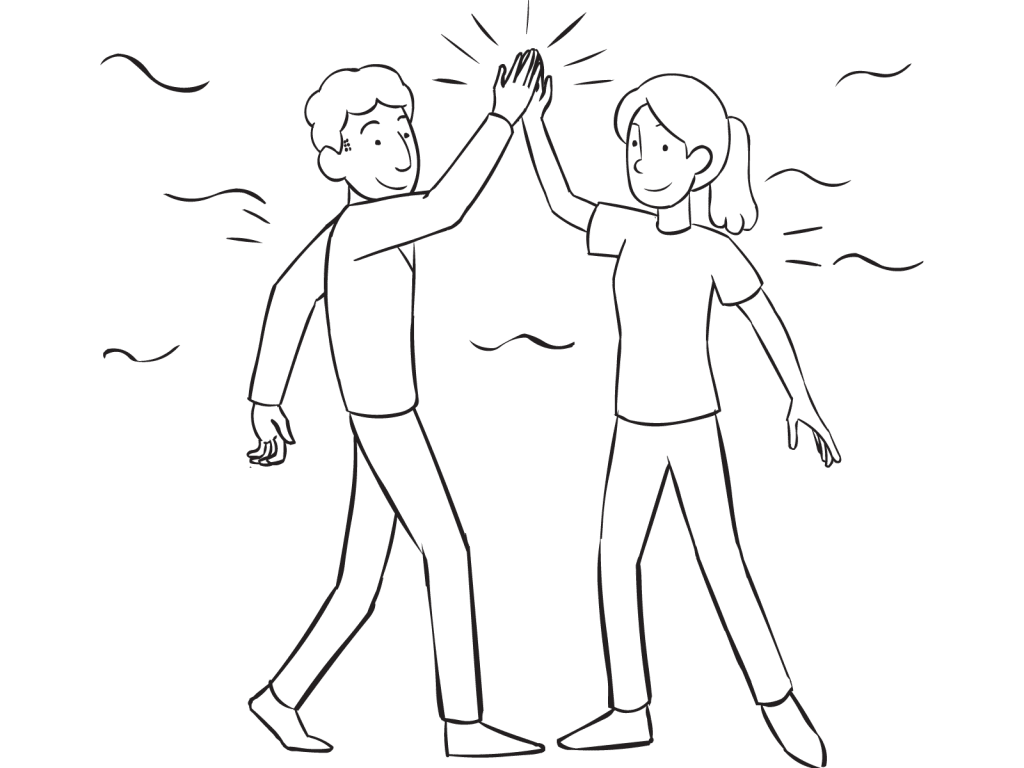
2. Crosstown Connections

Few things warm up a room faster than a good greeting. Crosstown Connections invites everyone to learn a handful of playful handshakes, each one with a different partner. Within minutes, people are moving, mixing and laughing as they meet people they might never have spoken to otherwise. Then the fun really starts, as the room erupts into a melee of people trying to find their partners again. It’s a terrific icebreaker for large groups, and a bonus for you too, because once these partnerships are set, you can call on them to form quick pairs for the rest of your program.

Recommended group size: 15 – 30 people

Typical duration: 15 – 20 minutes

Why it’s great:

  • No props
  • Very playful & fun
  • Everyone meets several people
  • Great for large groups
  • Ready-made partners for later
Clumps of small groups of three people gathered together as a quick grouping exercise

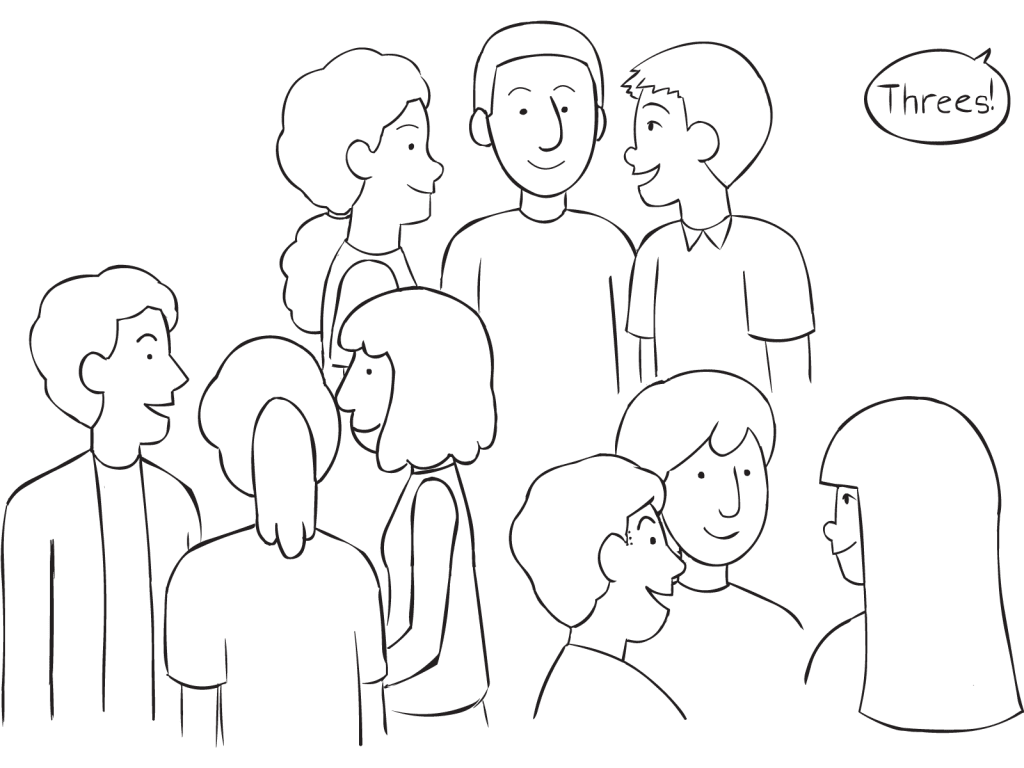
3. Clumps

Got a big crowd and not much time? Clumps transforms a large gathering into dozens of small conversations within seconds. You call a number, and everyone scrambles to form a group of that size. Then you call another, and another. There is a lot of noise, a little chaos and plenty of laughter, and nobody is put on the spot because everybody is busy finding a group. Add a quick question for each new group to answer and you have one of the simplest icebreakers for large groups I know. It is also a sneaky way to break up the cliques that form when friends arrive together.

Recommended group size: 30+ people

Typical duration: 5 – 10 minutes

Why it’s great:

  • No props
  • Extremely quick
  • Ideal for large groups
  • Mixes people randomly
  • Raises energy
Stop watch in foreground of group of people calling out their names, as featured in quick name circle game Name Impulse

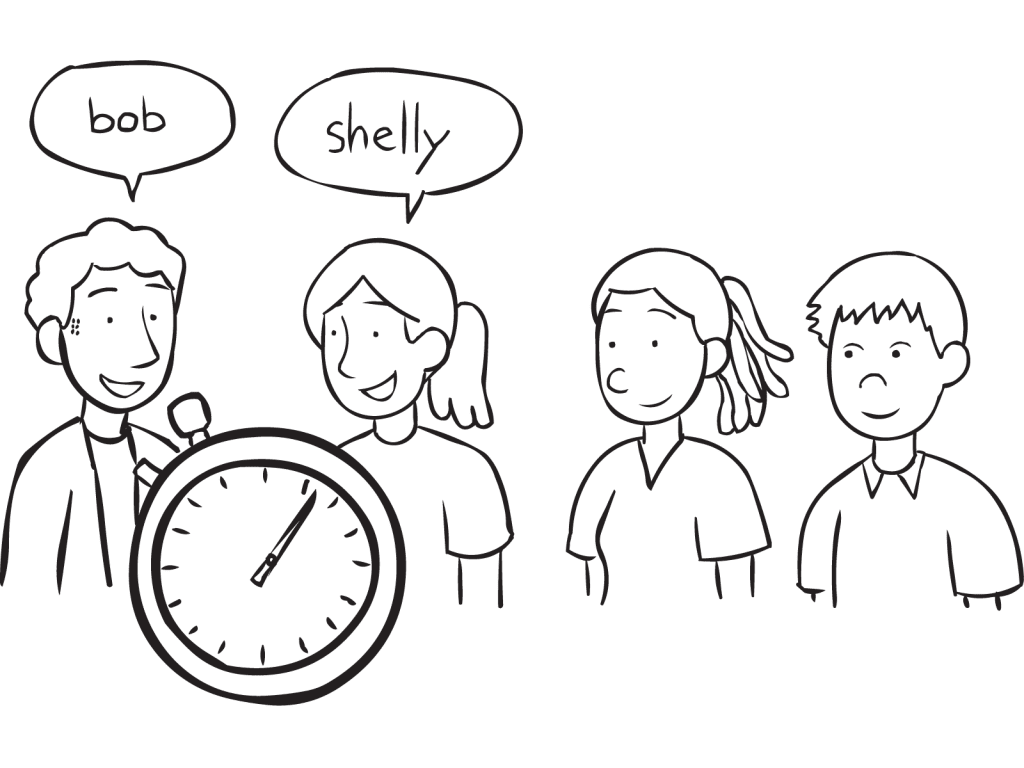
4. Name Impulse

Let’s be clear. Name Impulse is unlikely to help anyone learn too many new names. But it is a lot of fun, and that’s the point. Your group stands in a circle and sends their names around it as fast as they can, against the clock. Each attempt gets a little quicker, the names blur together and the giggles start. Because everyone is focused on the group’s time rather than on themselves, even the quietest people take part without feeling exposed. I’m grateful to Karl Rohnke for introducing me to this gem many years ago. It’s a simple way to hear every voice in the room in under a minute.

Recommended group size: 15 – 30 people

Typical duration: 2 – 5 minutes

Why it’s great:

  • No props
  • Very quick
  • Everyone’s voice is heard
  • Friendly group challenge
  • Great name-reminder
Four people standing in line with interlocked elbows, as part of Making Connections interactive icebreaker game

5. Making Connections

Strangers usually have far more in common than they realise. Making Connections shows them, quite literally. One person shares something about themselves, and anyone who has the same thing in common links elbows with them, then shares something of their own. Bit by bit, a chain of connections grows until the whole group is joined in one circle. Every link is a small success, and people choose what they share, so it never feels threatening. It’s a lovely icebreaker for a new class or team, and a gentle first step towards building relationship skills. If your group is reserved, go first.

Recommended group size: 8 – 15 people

Typical duration: 2 – 5 minutes

Why it’s great:

  • No props
  • Reveals common ground
  • People choose what to share
  • Connects the whole group
  • Works online too
Chad Littlefield headshot

Chad

Group Facilitator

"Since discovering playmeo, my facilitation has improved ten fold. It's that simple."

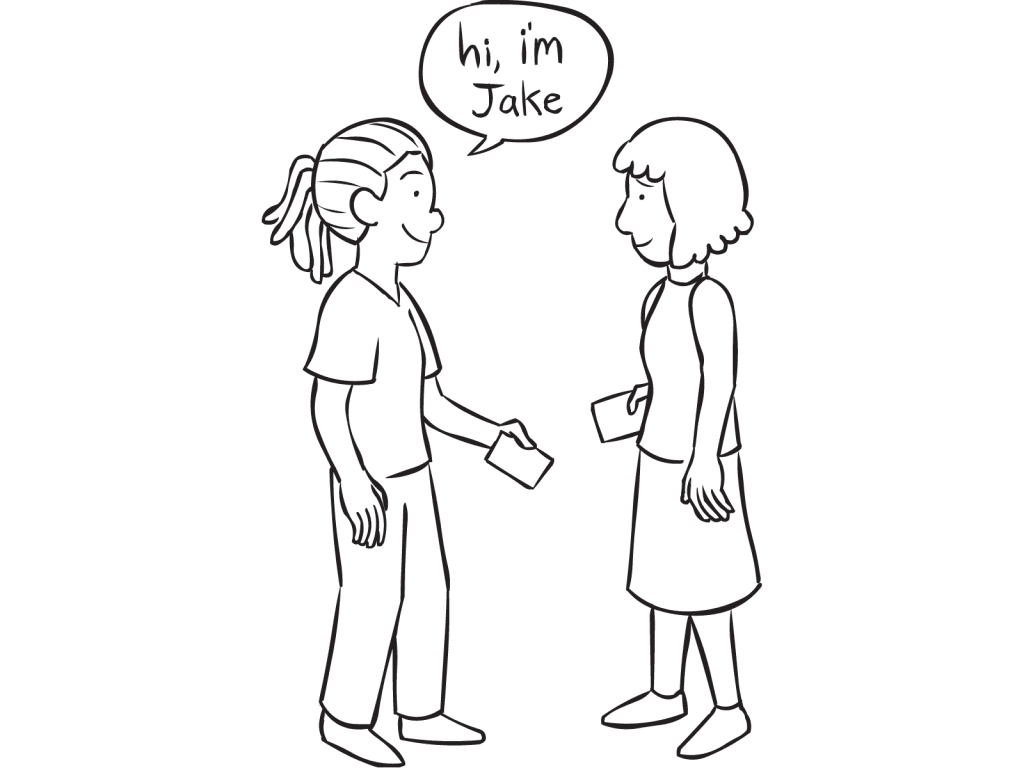
One person asking another a question printed on an index card as featured in conversational icebreaker activity Ice-Breaker Question Exchange

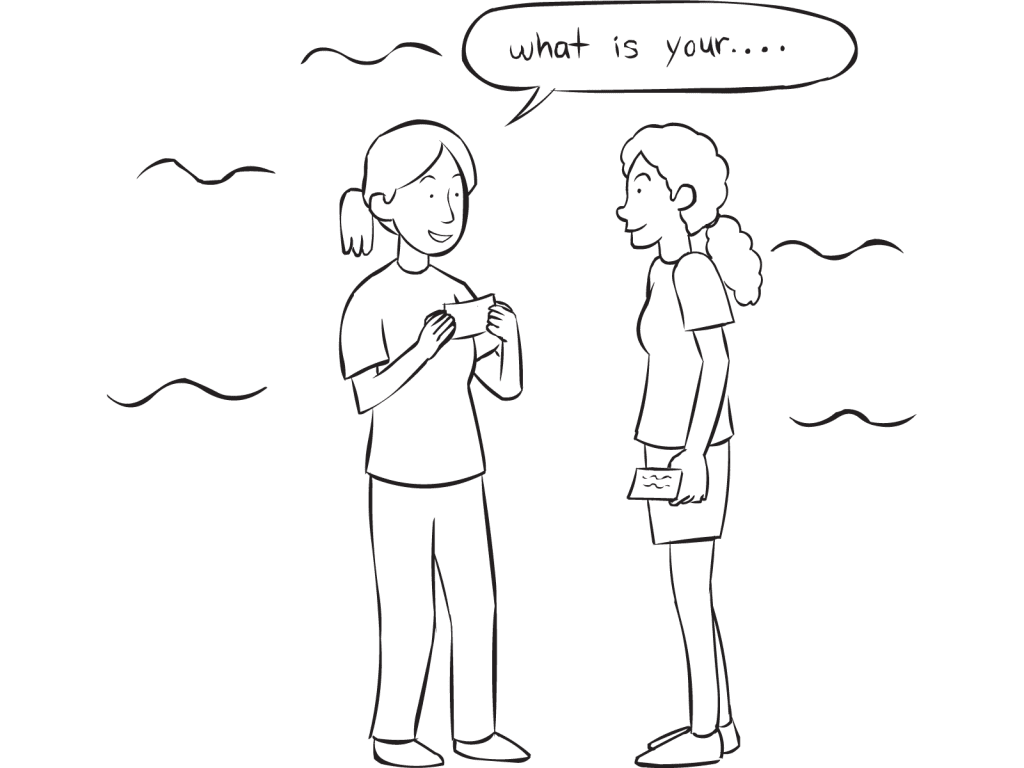
6. Ice-Breaker Question Exchange

Sometimes all people need to start talking is a good question. In this classic conversation starter, everyone holds a card with an interesting question on it. Partners swap questions, swap cards and then go looking for someone new, over and over. It’s simple, highly interactive and generates a surprising amount of energy. The secret is in the questions. “What is your favourite memory as a kid?” will get people talking, while “Tell me about your most embarrassing moment” will not. Remind people they can answer however they like, and share as much or as little as they want. Ready-made question cards are included for subscribers.

Recommended group size: 15 – 30 people

Typical duration: 10 – 15 minutes

Why it’s great:

  • Very simple
  • Non-threatening questions
  • Lots of one-on-one chats
  • Generates lots of energy
  • Works virtually
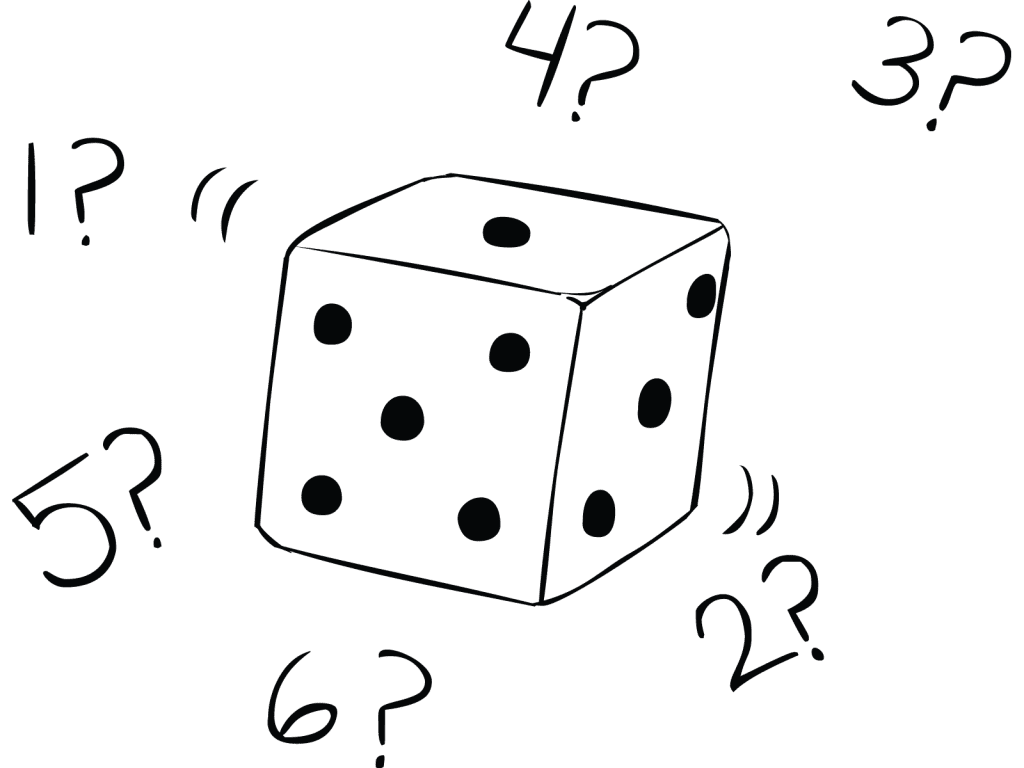
Illustration of playing dice as used in Dicebreakers dice sharing game

7. Dicebreakers

Come on, you have to admit the name is brilliant. Dicebreakers combines the thrill of a roll of the dice with a set of interesting questions, one for each number. Small groups take turns to roll and respond to whichever question fate delivers. I love the randomness, as much as the simple structure that gives everyone a turn to speak without anyone having to volunteer. A little suspense builds before each roll, which keeps everyone listening. It’s a terrific icebreaker for classrooms, workshops and team meetings, and once you have the idea, it’s easy to write your own questions to suit your group.

Recommended group size: 3 – 8 people

Typical duration: 5 – 10 minutes

Why it’s great:

  • Simple set-up
  • Non-threatening
  • Everyone gets a turn
  • Easy to make your own
  • Virtual option
Two women greeting one another as part of fun interactive identity game Identity Crisis

8. Identity Crisis

What happens when you introduce yourself as somebody else? Identity Crisis invites people to share a few fun facts with a partner, and then do something unexpected with them. Before long, the room is full of people cheerfully introducing themselves with the wrong name and someone else’s dream holiday. Half the fun is in getting the details wrong, so resist the urge to let people take notes. As I like to say, better to be wrong and get a laugh than to get it right and only get a smile. It works with new and familiar groups alike, and quietly sharpens everyone’s listening skills.

Recommended group size: 15 – 30 people

Typical duration: 10 – 15 minutes

Why it’s great:

  • Hilariously fun
  • Simple props
  • Mistakes are the point
  • Sharpens listening skills
  • Suits new & familiar groups
Illustration of This or That with arrows representing fun conversation starter game

9. This or That

Would you rather be poor in a job you love, or rich in a job you hate? This or That poses a series of tricky choices like this one, and invites partners to share their answers and then predict how the rest of the group will choose. Expect lively conversation, a few surprises and at least one person who insists “it depends.” There is rarely a right answer, which takes the pressure off. Because the questions touch on values, it’s a deeper icebreaker than most, so use it once your group has warmed up a little. It also works brilliantly as a communication exercise.

Recommended group size: 15 – 30 people

Typical duration: 15 – 20 minutes

Why it’s great:

  • Sparks lively conversation
  • No right or wrong answers
  • Reveals shared values
  • Deeper get-to-know-you game
  • Virtual options
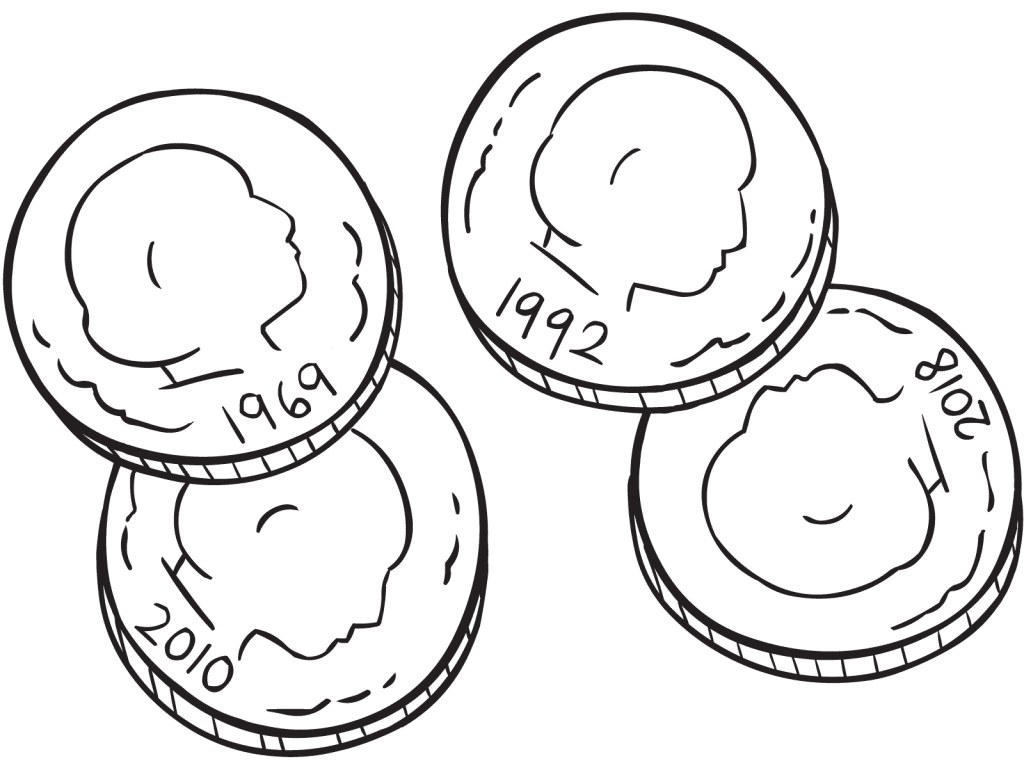
Four coins showing year of the coin which is used as part of curious icebreaker activity

10. Year Of The Coin

Every coin carries a year, and every year holds a story. In this curious icebreaker, each person receives a random coin and shares something they remember from the year stamped on it. The randomness is the magic. People find themselves recalling moments they hadn’t thought about in years, and unexpected connections soon surface around the group. Because it invites personal reflection, Year Of The Coin works best once your group feels safe to share, which is why it sits last on this list. Offer anyone the chance to swap their coin, and you’ll keep it comfortable for everyone. Coins from different countries make it even more interesting.

Recommended group size: 8 – 15 people

Typical duration: 10 – 15 minutes

Why it’s great:

  • One simple prop
  • Sparks personal stories
  • Reveals surprising connections
  • Invites reflection
  • Virtual option

Prepare Your Group For Its Purpose

An icebreaker is never just a game to fill the first five minutes. It’s how you turn a room full of individuals into a group that is ready to talk, listen, work and play together. Get it right and everything that follows is easier. Get it wrong and you will spend the rest of your program trying to thaw things out.

The ten icebreaker games and activities above will give you a great start. Choose the ones that suit your group and your purpose, begin with something light and playful, and invite people to share more of themselves as trust builds. And remember, the five ingredients matter more than the activity itself. If it’s fun, non-threatening, interactive, simple and success-oriented, you’re on the right track.

Above all, have fun. Laughter really is the quickest way to melt the ice.

Desktop laptop smartphone activity archive transparent

Unlock the Ultimate Toolkit

playmeo is the ultimate toolkit of icebreakers, energisers and team-building activities, trusted by thousands of group facilitators worldwide.

Subscribe today and unlock 550+ activities that will help you invite your groups to interact, share and build trusting and healthy relationships.

Subscribe Today

More Icebreaker Games & Get-To-Know-You Activities

shopping_bag Your Cart
Secret Link