


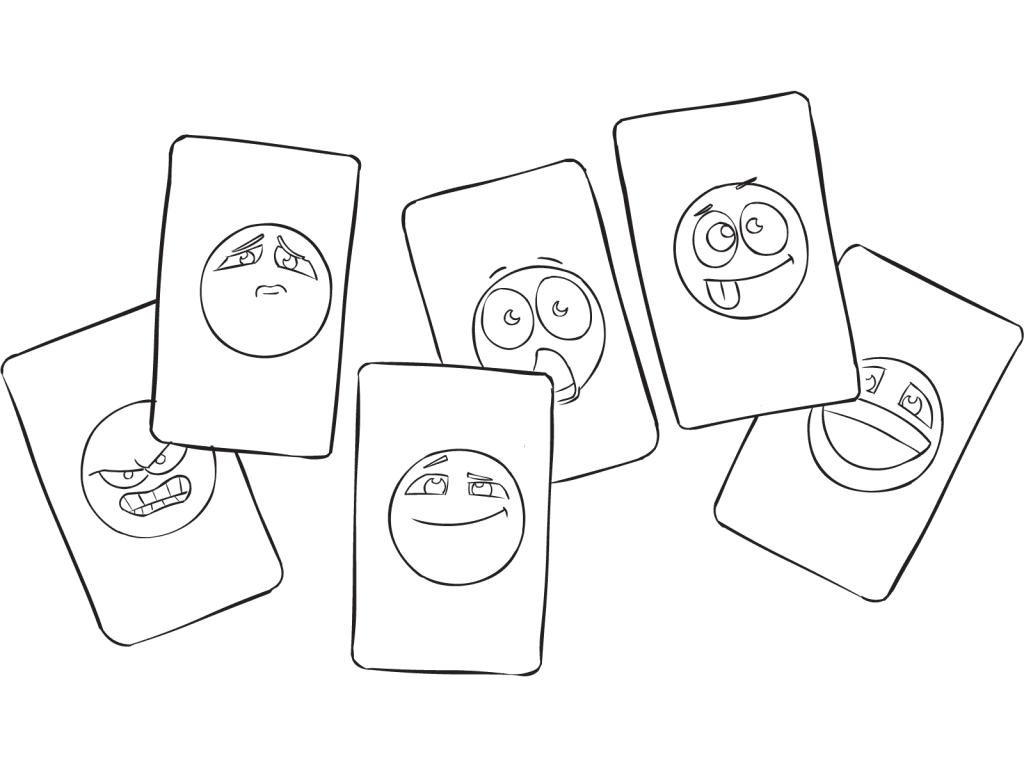
Emoji Cards
Emotional literacy cards to facilitate reflection & deeper sharing.
Emoji Cards
Emotional literacy cards to facilitate reflection & deeper sharing.
Emotional Literacy Cards
These emotional literacy cards provide a powerful visual language for helping people express complex feelings after activities or experiences. Emoji Cards offer participants a safe entry point to articulate emotions that might otherwise remain unspoken. Using familiar emoji images creates an accessible framework for personal reflection, encouraging authentic conversations that deepen understanding and connection.
Step-by-Step Instructions
expand_circle_down- Lay all Emoji Cards randomly on a table or the ground.
- Gather your group around the cards, allowing them a few moments to become familiar with them.
- In pairs, ask each person to pick one or two cards that reflect a feeling they experienced during the activity.
- Encourage people to share why they picked the card and why it was so significant to them.
- Allow two minutes for sharing.
- If time permits, re-gather your group and invite volunteers to share anything that they learned that they believed was significant.
Resources
expand_circle_down- Set of Emoji Cards
Video Tutorial / Transcript
expand_circle_downVideo Transcript for Emotional Literacy Cards – Emoji Cards
presented by Mark Collard
Just take a moment now to look at these emojis. We use them every day in our socials and emails and all that other stuff and this is a representative sample of many of the emotions and feelings that we as humans feel at any point in time. And so just cast your eye over some of them but with this lens, think about your experience so far together in this programme and I’d like you to think of one moment in particular where you had a particular experience that evoked a feeling, an emotion.
It might have been one of frustration or challenge, of joy, of shock, confusion, any of those. There’s 50 names I could give to all those emotions. So take a moment and identify one that you think, yeah, doesn’t have to be the best one or the most memorable.
Just pick any one of your emotions or feelings that you personally experienced during the course of our programme so far. For example, I might choose this one here. There was a moment where I was feeling pretty cool.
Okay, so once you’ve caught yourself and you’ve got that card and like if you’re all going to just scramble over the same card, have a plan B or plan C. But grab that card and then I invite you to go find one or two people just at your own pace to share why did you pick this card, maybe explain a bit about that experience. Then here’s the hard part, lean in and listen to your partner. Like most communication, it’s not about waiting your turn.
It’s about actually listening to the partner that you’re going to be sharing with. So once you’ve heard their thing, thank you for sharing. Maybe go find a second or maybe even a third person.
I’ve got more I want to share, but as we wait for people to arrive, got the basic idea? Yeah. Start when ready. And return your emojis to the table.
Like most resources, I think some of the most valuable resources in your kit should be those that are very versatile. So that is that just don’t have one use. And so in a quick medley, I just want to introduce a couple of different ways this could be used.
And then one of them is going to actually involve the whole group. But for example, I might just take a random selection of 10 or 15 or 20 cards, let’s say these ones and ask a group of people to form a straight line according to the most negative to the most positive emotion. Bless you.
So positive to negative emotion or the most pleasant to the most unpleasant, or the one that exhibits the most amount of energy or takes the most amount of energy to remote to the least amount of energy. There’s all sorts of different paradigms that you could use for that perspective. Now, without having to do it, do you think that there’s a correct answer to the lineup the way they go? No.
And so it opens up conversation. So Abigail’s group may have done it a particular way, and then I might go have a look at it and want to change it. It doesn’t mean they got it right or wrong, but it’s now a starting point.
And you might go, Oh, but it’s the nuance. It’s the little delicate moments that you see inside an emoji that makes you go, Oh, it’s either one way or the other. You could do with all 50.
That’s just overwhelming. So I often do it with just smaller groups. Um, you’ve already understood the benefit of using it for purposes of reflection.
You know, when I asked you that question, think back to our earlier part of our programme, find a moment you could choose any moment. And then you had a chance to share it with somebody else. Help me out now.
Flip all the cards over. Notice that there’s a variety of colours and inside the pack, there comes one card and you don’t need to focus on this, but just have a quick look at what happens when you put all those 50 cards together. They end up on a beautiful matrix.
Now, while I created this prop, I did not create this matrix. Have you ever heard a young person or an adult say I’m in the red zone. Okay.
That comes from the world of positive psychology. And so red, blue, green, and yellow. We, we experienced all of these all the time.
So here’s your group initiative. You’ve seen the basics and every one of those cards fits in here somewhere. Let’s just take a minute or two to see how long it might take you to recreate this matrix.
And then I’m going to use it in a really powerful way. But your first task is to recreate the matrix. Red is in the top right, top left-hand corner, then blue underneath it, green in the bottom right, and yellow in the top right.
Go. There is only one solution and it’ll be really clear when you get it right or wrong. I’ve got this backwards.
10 is on the horizontal. Nice. Starting to pull it together now.
Very good. Okay. So well done.
You now have the complete matrix. You’ve got your 10 by 5 cards. And it’s really interesting when they’re all spread out and you might just find these two cards kind of just kicking around.
They almost look the same. What’s really interesting, and this comes back to context, is when you swap it around, how bad that now looks. Like, bam, even though out there on their own, they look like they actually look the same.
Now when context, it suddenly looks really, really different. So there’s just one way that the actual activity can be really, really powerful. But now I want to lean in for its actual purpose.
If you are working with young people, but to be fair, working with adults who are still building their emotional literacy, and I don’t know about you, but that’s a big part of the curriculum for me back home, is building emotional literacy. This is a great way because you know that someone, young person, adult, is having a big feeling. I think of an 11-year-old son.
He’s having a big feeling. And if you’re to say, so how are you feeling right now? He hasn’t got the words. They haven’t built that vocab yet.
This can be a great way around that. Come a little bit closer and notice a few things now. One, there are two axes.
The bottom axis is level of pleasantness from unpleasant to very pleasant. Look at the way the grey and across the whole thing from pleasant to unpleasant. That’s right.
Yeah. Unpleasant to pleasant. And then here is the level of energy, low energy to high energy.
So you may just ask two questions. Hey, Peter, I know you’re having a big emotion or a big feeling right now. On the scale of one to 10, is it unpleasant or very pleasant? 10 being the most pleasant.
Oh, it’s probably about a four. Okay. Got it.
And then level of energy in order to emote that, to actually express it. Do you feel like it’s just something that just happens or do you feel like there’s something really building up inside you? Oh no, it’s pretty high. It’s about a seven.
So you can just plot it. So it’s one, two, three, four, and then go up seven words. And it’s going to be somewhere around there.
You might even flip the card over and go, is that kind of like what you’re feeling right now? Or if it’s not bad, it’ll be somewhere around it. Every card have two words that come close to capturing what that emoji is trying to say. Now, is it the right answer? No, but it gives you a starting point on which you can then discuss.
So in the school of psychology, these 100 words have been somehow scientifically developed and collated to represent the full array of emotions that humans have. So it’s going to work. It’s going to map on here somewhere.
So we’ve seen it as a reflection tool, as a group initiative. And now if you work in the world of social emotional learning, emotional literacy, and you can use that, I’m sure you can think of other ways in which it can be used. So I’m using it a great deal for that purpose.
Sometimes it’s just for one of them. Like I just want the group initiative. I want the group to be able to work this out.
Or it’s something else that we’re doing related to emotions. Any thoughts? We’re going to keep moving forward, but any thoughts that people out of this comes up for you, that raises for you? It’s crazy to think that there’s 100 words there. Like 100 words just seems like a lot.
It does. So there’s 50 cards, and I think we can all agree there are two on every card. Yeah.
In the same way when we flip them over, there’s 50 emojis there too. And that doesn’t get them all. Like we know of many emojis that you would use day to day.
Anything else? I love the teaching point that in unpleasant, there are unpleasant emotions or states that require a lot of energy. You’re really working to be like this. Yes.
Yeah, exactly. A livid, fuming, enraged, a very different to alienated, despondent, despair. At the same end, serene, carefree, and balanced.
Very low energy compared to ecstatic, elated, excited. It’s true across the way, left or right, X or Y axis. You have to work yourself up to get up here.
Like a part of that’s how you’re responding. Yeah. That comes back to choice.
That’s a very powerful conversation to have with anyone. Maybe not at the moment. They’re in the red zone.
Then you want to move them into this melting pot. Maybe it’s the green zone. Maybe it’s the the blue zone.
But if you work with teachers, they will have this vocab. I hear it all the time with my son’s teacher talking about a kid who’s in the X zone, whatever that zone is. I like how it’s kind of fluid and it blends together.
Because I think if I’m like, oh, I’m so livid right now, I feel stuck there. But knowing that I’m really close to like, connect or I don’t know, like you can travel through it. Does that make me feel stuck knowing that the others are kind of close? Yeah.
And that’s where you are right now. So what would it mean for us to move back to the blue zone? What would we need to do? Yeah. Or to move away from unpleasant to pleasant.
What would we need to do as a group or to change or to take on or be responsible for all of those things? Now you’ve got something to work with rather than just these nebulous words that sort of fill the air.
How To Play Narrative
expand_circle_downThere are just so many uses of these playful and innovative cards, it’s hard to know where to start. Emoji Cards are perfectly suited for use as an ice-breaker, energiser, problem-solving initiative and a reflection tool.
For now, I will focus on their use as a reflection tool. Take a look at the many variations described in the Variations tab for more ideas.
Lay all of the cards (there are 36 of them) on a table or the ground, and gather your group around them. Take a moment to allow your group to survey their various caricatures.
Presuming your group has just completed a significant experience, ask them to pick one or two cards that express one or more of the emotions they felt during the activity. If you have a large group, it is easier to invite people to identify the cards and not pick them up.
From here, either invite people to share with one other person, or invite a series of volunteers to share in front of the whole group.
Encourage people to share why they picked a particular card, and what was so significant about the emotion they experienced.
Practical Leadership Tips
expand_circle_downOne of the most powerful benefits of these cards, when used in a conversation, is that the focus is on the cards, and not necessarily on the people. For some people, this makes sharing a lot more comfortable.
Beware – these cards clearly focus on emotions and feelings, hence this topic can make people quite vulnerable. To this end, consider your sequence, and the environment you have created to foster a safe place to share. When in doubt, always invite sharing in pairs or groups of three or four people.
Social-Emotional Learning
expand_circle_downYou could integrate Emoji Cards as part of a well-designed SEL program to help your group understand their emotions, thoughts and values and how these influence behaviour in different situations.
Specifically, this activity offers opportunities to explore and practice the following social & interpersonal skills:
Self-Awareness
- Identifying Emotions
- Linking Feelings, Values & Thoughts
- Identifying Personal, Cultural & Linguistic Assets
- Recognising Strengths, Prejudices & Biases
- Demonstrating Self-Confidence, Honesty & Integrity
- Experiencing Self-Efficacy
Self-Management
- Identifying & Managing Stress
- Demonstrating Self-Discipline & Self-Motivation
Social Awareness
- Taking Other’s Perspectives
- Demonstrating Empathy & Compassion
- Appreciating Diversity
- Respecting Others
Relationship Skills
- Communicate & Listen Effectively
- Seeking and/or Offering Support
- Build Positive Relationships
- Demonstrate Cultural Competency
Responsible Decision-Making
- Promoting Personal & Collective Well-Being
You can learn more about SEL and how it can support character education here.
Health & Wellness Programming
expand_circle_downEmotional Intelligence
Emoji cards are nothing if not a wonderfully simple and creative tool to help your groups build their emotional literacy. Particularly for young people, the emojis depicted on the cards can be a powerful prompt for people to identify and understand how they are feeling. As described in the Variations tab, there are many ways in which you can use the cards for processing the feelings of your group. This process is useful to guide one’s self-awareness as much as understanding the emotions and perspectives of others.
The cards offer two options for reflection – the emoji images and the words. While the two words which appear on the flip side of each emoji card are not strictly connected to that image, they do offer a useful prompt when building one’s emotional literacy. When working with young people, perhaps focus on the background colour of the cards and alternative words if necessary.
Popular Variations
expand_circle_down- Team Initiative: Assemble all of the cards from happiest (most positive) to saddest (most negative.)
- Time of Your Life: Randomly distribute one card to each person in your group. In pairs, ask each person to share with their partner at least one time that they experienced this feeling in their life.
- Empathy for Others: Pick a card which you think reflects how someone else may have been feeling during an experience. Share this observation with someone other than the person nominated, or directly to this person. A higher-level challenge would be to share these observations publicly.
- Arrival Activity: Invite individuals to pick a card or cards which reflect how they are feeling as they enter the space, or start of your program. Invite people to find one or two others to share their thoughts.
- Story-Telling: Randomly distribute a set of 5-8 cards to small teams, and ask them to create a story in which every emotion is utilised. In advance, consider if you want the story to focus on fun or function to guide the impact of your group’s deliberations.
- Name That Feeling: Ask an individual to pick one random card from the pack, and non-verbally demonstrate/model this emotion in front of a group, asking them to agree on the name of the emotion being expressed. If possible, encourage your group to achieve group consensus.
- Spot The Difference: Deliberately select two cards which appear to express very similar emotions. Ask your group to identify and discuss their similarities, differences and subtleties in emotions. This conversation is ideally to develop awareness and empathy for others.
- Take a look at UBUNTU Cards, We Connect Cards, Climer Cards and Fine Line Cards if you enjoy the simple pleasure of using awesome props in your programs.
Virtual Adaptation
expand_circle_down- Create one or more digital boards with a bunch of emojis on the screen. Once displayed, your options for their use are as many as described in the Variations tab. For example, take a look at this simple emoji reflection board created in padlet. You are welcome to use this with your groups, but of course, you can produce your own.
You Might Also Like...
expand_circle_down


Useful Framing Ideas
expand_circle_downIt may sound like:
- “LOOKING AT THE CARDS LAID OUT BEFORE YOU, I’D LIKE YOU TO PICK JUST ONE CARD WHICH YOU THINK MOST CLOSELY REFLECTS AT LEAST ONE OF THE FEELINGS YOU EXPERIENCED DURING THIS LAST ACTIVITY…”
- “YOU HAVE ALL BEEN GIVEN A RANDOM CARD FROM THIS PACK OF EMOJIS. YOUR TASK NOW IS TO FIND ONE PERSON IN THE GROUP YOU DO NOT KNOW VERY WELL, AND SHARE WITH THEM AT LEAST ONE TIME YOU HAVE EXPERIENCED THIS FEELING IN YOUR LIFE…”
Source
expand_circle_downThe inspiration for, and the original developers of the emotional literacy cards Emoji Cards was Paradigm Shift (USA.) You can purchase the latest playmeo-designed deck of Emoji Cards by clicking the following link:

EMOJI CARDS
Fun, multi-functional cards featuring full range of emoji-style emotions

BEST-SELLING CARDS Bundle
Get four of playmeo's best-selling interactive card decks together & save

Comments (3)
lock_open